
Sarah Joseph: When Prostration Made Surrender Visible
العربية · English · 简体中文 · हिन्दी · Español · Français · Deutsch
When They Discovered Islam
Sarah Joseph grew up inside a world that looked intensely glamorous from the outside. Her mother, Valerie Askew, ran a modelling agency while supporting five children as a single parent. Sarah later said that she was raised in the agency from her first weeks of life. She saw beauty and fashion at close range, but she also saw the work behind them. Surrounded by beautiful faces, appearance lost some of its power to impress her, and she learned to ask other questions: Was a person kind? Truthful? Considerate of others?
Before Islam, she was a devout, practising Roman Catholic. She also remembered a strong spiritual sense from childhood and a concern for social justice. She was not looking for a religion to fill a merely material emptiness, and she knew little about Islam. What she wanted was to give her life to God, though she had not yet found a framework that joined faith, mercy and action coherently.
The opening came through a family event that was not initially about her. Her brother fell in love with a Muslim woman and converted in order to marry her. Sarah saw little religious change in him, yet the news redirected her own life. Her mother told her that Muslims believed Jesus had been born to the Virgin Mary. Sarah did not believe it. Later, in a library, she found a Qur’an, checked the index for Jesus, and discovered that her mother was right.
That fact did not make her Muslim. It taught her something decisive: an inherited picture of another faith may not match what that faith says about itself. Returning to sources became part of her search rather than a passing moment.
During this period she lost confidence in the Catholic Church without losing her belief in God. In her own account, her crisis centred especially on papal infallibility as she understood its historical development, and on questions about original sin, the crucifixion and the history of the Gospels. The collapse was painful. She was not casually abandoning a community in which she had worshipped, but she said that God did not disappear when her confidence in the institution did.
She continued reading about Islam and asking questions. The Qur’anic continuity of the prophets attracted her, as did the account of Adam and Eve sharing responsibility, repenting and being forgiven—leaving no inherited guilt for their descendants. She was also struck by prophetic narratives that placed people before choice and responsibility. For her, these were not isolated points of doctrine. They addressed the questions exposed by the loss of her former framework: What is the human relationship with God? How can justice, mercy and repentance belong together?
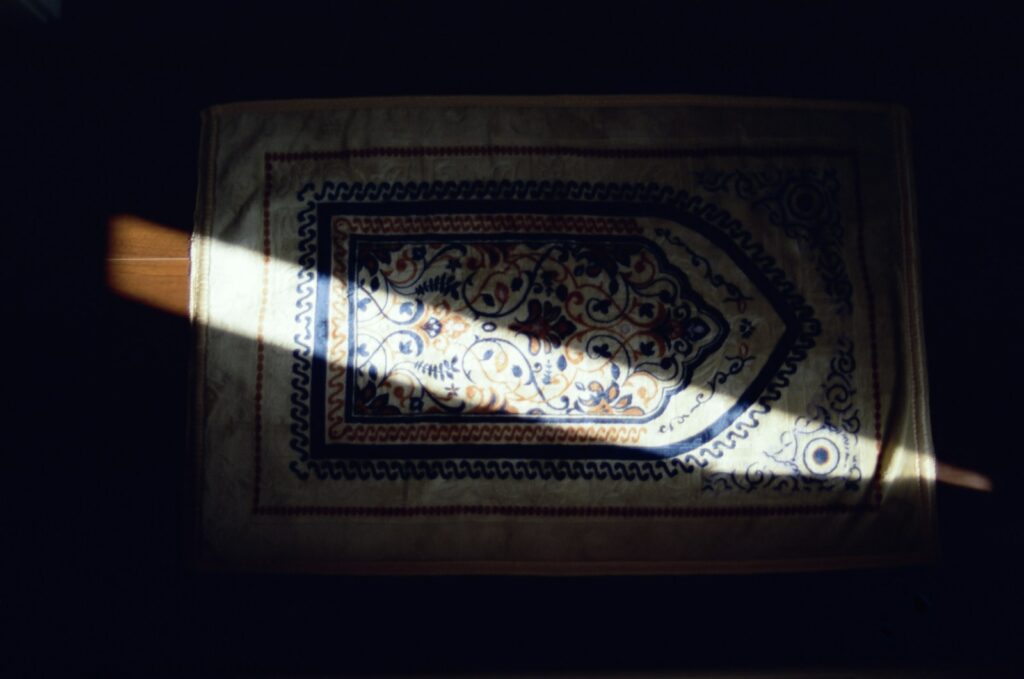
Joseph said that Islam kept offering answers as she asked, while her central desire remained the same: to surrender her life to God. Then she saw a Muslim girl go down in prostration during prayer. She did not report a sermon or a conversation at that moment. What her testimony preserves is that the prostration made visible what she had been reading: Islam as self-surrender to God. At that point, she decided to embrace Islam.
She was sixteen. The available sources place the conversion around 1987–1988 without establishing a single secure calendar year. In her account, the important distinction is clear: she did not convert under her brother’s pressure or for marriage, but through her own investigation and an older desire to worship God.
The test followed quickly. Wearing the headscarf appalled members of her family. Her grandmother thought it made her look foreign; her mother feared that she had surrendered female emancipation and closed off future opportunities. Sarah connected the choice to prayer and to her long-standing discomfort with reducing women to appearance. When she began covering her hair in 1988, she said many people did not read it as religion at all. They racialised her, and she endured abuse after moving through society as an unremarkable white English girl.
She did not hide the pain of being seventeen and suddenly treated as an outsider, but she did not let that become the end of the story. She later studied theology and religious studies at King’s College London and became a writer, broadcaster and lecturer. In 2004 she received an OBE for services to interfaith dialogue and the promotion of women’s rights. After the attacks of 11 September, she spent long periods speaking about Islam in schools, universities and places of worship, until she felt that defining Muslims only by what they opposed drained the meaning from the work.
She and her husband therefore founded emel magazine to describe what they believed Islam stood for: justice, beauty, service to others and care for the world. She wanted faith to be visible in home, work, culture and the environment, not only in politics or ritual. In a later interview she described two wings that had accompanied her through life: belief in the Divine and social justice. What she had searched for as a teenager became the centre of decades of work.
Joseph’s story is inspiring because it is not a leap from ignorance to an instant answer. It begins with correcting one assumption, moves through source-reading and painful theological questions, and reaches a meaning she saw embodied in prayer. Islam did not remove every difficulty, but it gave her a path through which study, worship and public service could reinforce one another.
Her journey leaves a practical question: do we know another faith from inherited images, or from its sources and the testimony of those who live it? Her path began with the courage to verify a small claim. It matured when the desire she had carried for years—to live for God—became worship, responsibility and work for the common good.
The question this story answers
Does losing trust in a religious institution require losing faith in God? In Sarah Joseph’s experience, faith remained and pain drove her to investigate. Islamic teachings about God, repentance and the continuity of the prophets addressed her questions; prostration then became a visible expression of what she sought—to surrender her life to God.
Sources
Photo: Ahmed Nishaath / Unsplash.