
The Pen That Looks Like Mine
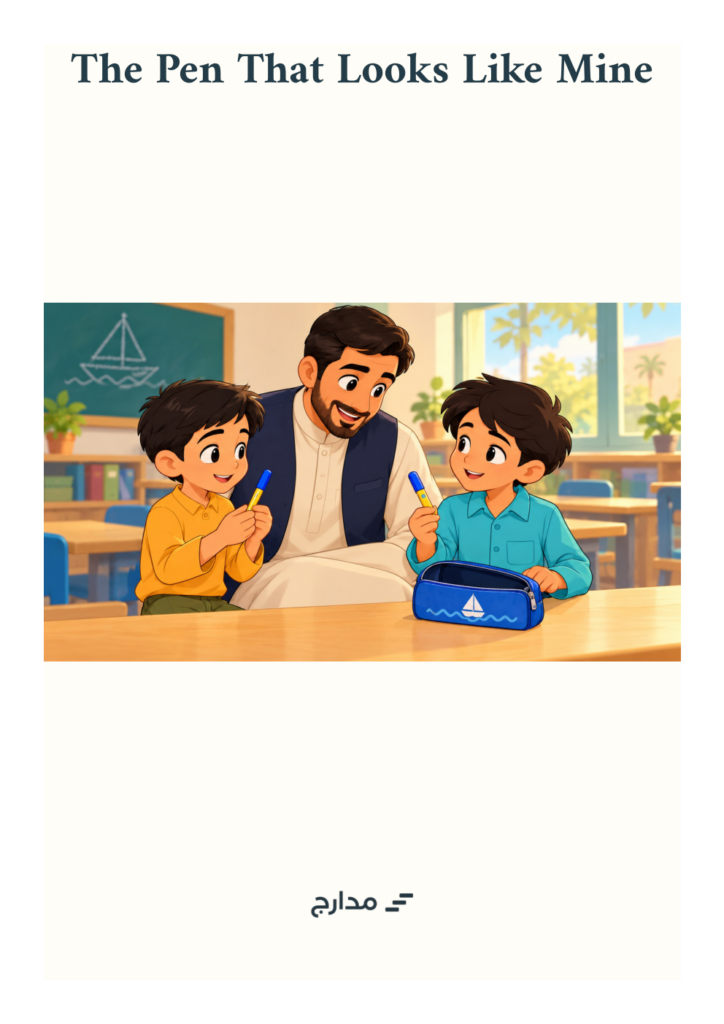
C05 · 6–8
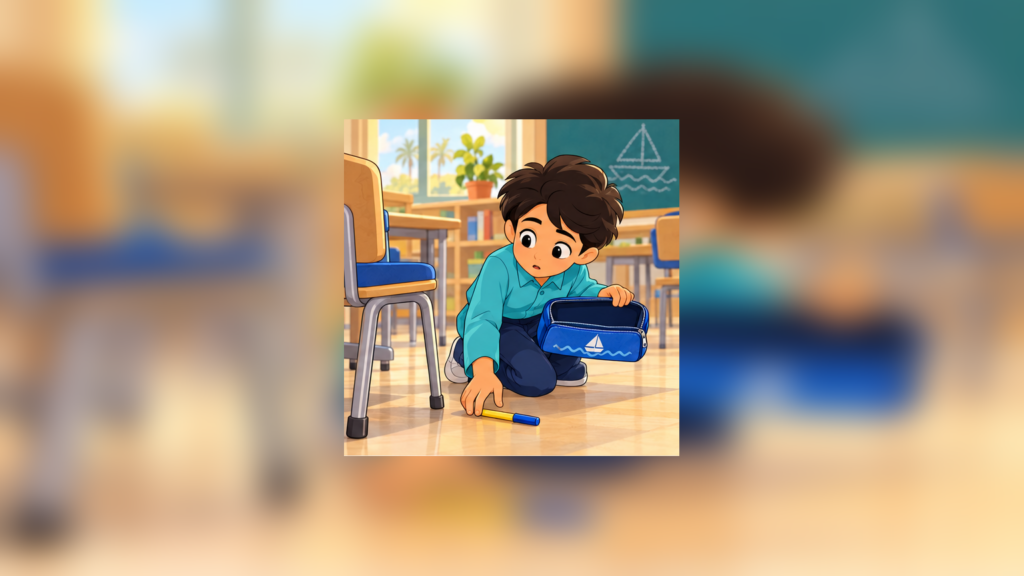
After art class, Salman spotted a yellow pen beneath a chair. It looked exactly like his favourite pen: a blue cap, a yellow barrel, and a fine tip.
Salman and his classmate Mazin were seven-year-old boys. Their teacher, Mr Hassan, was a thirty-five-year-old man.
Salman opened his pencil case. His pen was not there.
Then this one must be mine, he thought.

He reached for it, then stopped. Dad had placed a tiny blue dot beneath the cap of Salman’s pen so it would not be mixed up with the other pens in class.
Salman lifted the cap once. There was no blue dot. Instead, the pen had a small silver scratch.

He took it to Mr Hassan.
“This pen looks like mine, but my mark is not on it,” he said. “What should I do?”
“You did well to look for one clear sign,” he replied. “Put it in the lost-property box. Returning someone else’s belongings is a duty. Then we can look for your pen.”

Salman placed the yellow pen in the box. Two steps later, he turned back.
“What if the blue dot rubbed off?”
Mr Hassan asked, “Did you find any new sign that changes what you saw?”
“No.”
“Then we do not repeat the same check for the same doubt. We chose a clear sign, checked it, and acted on what we found. If new evidence appears, we can look again.”

On a card, he wrote three questions:
What is the clear sign?
Did I check it?
Is there anything new?
Mr Hassan pointed to the card. “A clear sign protects the pen’s owner, and it also frees you from repeating the same doubt. If you remember another real mark, we can check it. But the word maybe, all by itself, is not new evidence.”
Salman read the questions once.
“The clear sign is the blue dot,” he said. “I checked for it, and it was not there. Nothing new has appeared.”
“Then checking this pen is finished,” Mr Hassan said. “Now your search for your pen can begin.”
Salman moved his drawings away from the edge of the table so they would not fall while he searched. He placed his bag where there was more room, took out his small notebook, and put it back. He did not ask his friends to empty their bags. He was searching among his own things first, while the other pen stayed safely with the teacher.
Salman began looking for his own pen. He checked beneath his sketchbook, then opened the side pocket of his school bag. There it was. When he lifted its cap, he saw the tiny blue dot.
Salman laughed. “My pen was waiting in my pocket!”

Before the end of the day, Mazin came to the lost-property box.
“I lost a yellow pen,” he said. “It has a little silver scratch beneath the cap.”
Mr Hassan matched the mark and returned the pen to him.
“Thank you for not taking it just because it looked like yours,” Mazin said.
“One clear mark was better than ten worried looks,” Salman replied.
Salman looked at the two pens together. From a distance they looked alike, but their marks were different. He put his pen back in his pencil case and closed its cap. Mazin wrote his name on a small card and tucked it into his bag pocket to remember where his pen belonged after class.
The next morning, Salman tucked the question card into his pencil case. The card did not say, Never check. It said: Check one clear sign, then move forward. Do not let the same doubt pull you back again and again when nothing new has appeared.