
I Prayed… Then I Practiced
C08 · 6–8

Mazen was a seven-year-old boy. His father was a thirty-six-year-old man, and Mr Nabil was a thirty-five-year-old man. His classmates were seven-year-old boys.
Every morning, Mazen passed the class noticeboard and read whatever words he could. On Monday, his male classroom teacher, Mr Nabil, said, “Tomorrow, we need someone to read our Book Week announcement to the class.”
Mazen’s hand shot up. Mr Nabil smiled and gave him the announcement card. Most of the words were familiar, but two were long and tricky: “library” and “participation.”

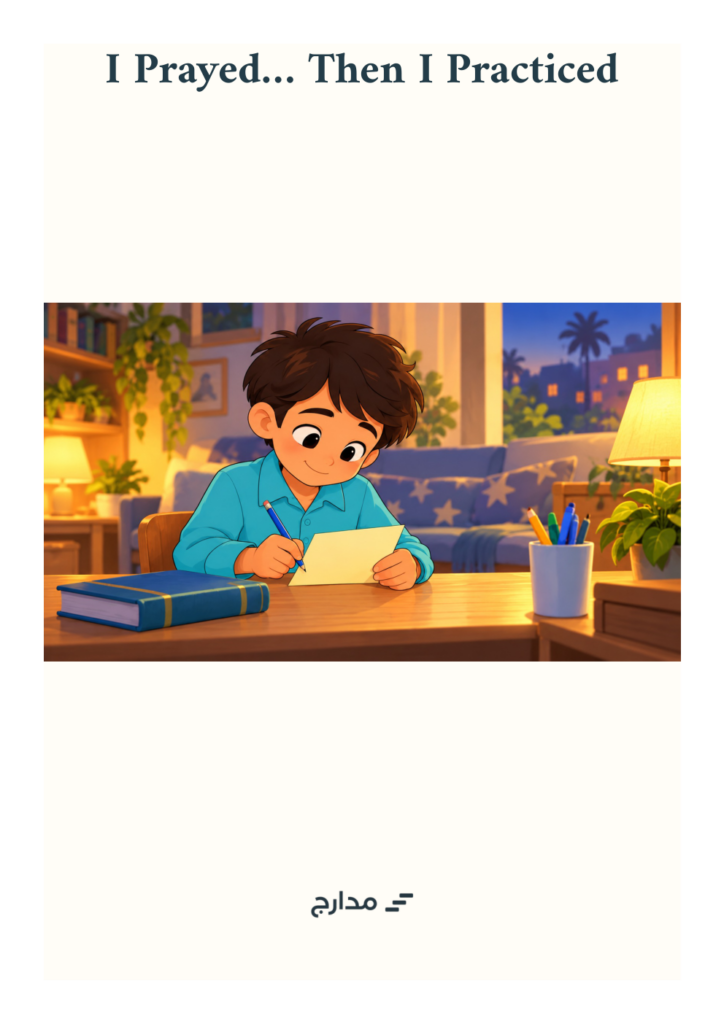
At home, Mazen placed the card on his desk. “I’ll ask Allah to help me read well tomorrow,” he thought. He made a simple dua. Then he noticed his colored blocks. He built a bridge, then a tower, and forgot all about the card.

Before bed, he tried to read the announcement once. He stopped at “participation” and mixed up the sounds in “library.” Feeling upset, he went to his father.
“I prayed,” Mazen said. “Why am I still stumbling?”
His father sat beside him. “Dua is worship, and we ask Allah for help. Part of accepting help is using the means we are able to use. What can you do right now?”
Mazen looked at the card. “Practice.”

His father did not tell him to read the whole announcement twenty times. Instead, he divided it into three lines and placed a small pencil mark under each difficult word. First, his father read “library” slowly. Then Mazen tried. He missed it once and got it the second time. After each line, they paused.
Mazen moved the card nearer the lamp and cleared the blocks from the edge of his desk. He tried to rush the whole word out in one breath, then stopped. His father pointed to the small mark. Mazen returned to the first sound and tried joining the parts again. Mazen covered the other two lines with a closed book, leaving one small task in view. When he could join the sounds, he read that line at his usual pace. Then he laid his pencil beside the card to remind him where to pause in the morning.
“There will be time for one short practice in the morning,” his father said. “We cannot promise ourselves a reading with no mistakes. We do what we can and ask Allah for success.”

The next morning, Mazen read the card twice. When he stood before the class, his voice began clearly. Then he reached “participation” and stumbled. For a moment, he wanted to lower the card and stop. But he remembered the small pencil mark. He took a calm breath, sounded out the word one part at a time, and finished the announcement.
It was not a perfect reading. He repeated one word and missed a pause. Yet he did not hide from the mistake, and he did not pretend that praying meant he could skip practice.
After the lesson, Mr Nabil said, “You did well to pause and continue. Next time, let the full stop show you where to rest.”

Mazen wrote Mr Nabil’s note on the back of the card. When he came home, he told his father, “I prayed, then I practiced, then I stumbled a little… and then I carried on.”
His father smiled. “That is a good sentence for the beginning of your next practice.”
Mazen placed the card beside his book. It was not a trophy for reading without mistakes. It was a reminder that one stumble did not close the way forward: he could pray, begin, and return to what needed improving.