
My Name Under an Unchecked Report
F20 · 16–18

Yasir had ten minutes before the exhibit coordinator closed the allocation sheet. At seventeen, he had taken on the school technology club’s reporting, and this was the first readiness report he would send under his own name. A short form filled the screen. To his left lay the inventory sheet that Marwan had handed him. Marwan, his eighteen-year-old clubmate, was still at the back shelves reading box labels and moving the boxes he had checked to one side. Their supervisor, thirty-four-year-old Fuad, was arranging display tables in the next room.
Yasir opened the inventory file and gave a writing tool the working copy the club had prepared for the exhibit. He asked for a short report stating how many invention kits were ready for the visiting teams. The answer came back in three tidy lines. The first contained a sentence he could paste straight into the form: forty-eight complete kits were ready for distribution. The answer used the exhibit’s name and put the number where the coordinator expected it. He pasted the sentence into the report and added that the club could receive teams according to the stated number.
The signature box was still blank. The inventory sheet had folded over at the edge, hiding its last column. Yasir reached for it just as a reminder about the deadline appeared. He brought his hand back to the keyboard. He checked the club’s name, corrected a comma and looked once more at the figure. He could have unfolded the sheet and traced the number to its column. Instead, he typed his name in the box marked “Prepared and approved by,” selected the coordinator’s address and clicked Send.

The coordinator’s confirmation arrived a few minutes later. Yasir opened it as he gathered his papers. The exhibit schedule now set aside forty-eight places for teams using the club’s kits. Just then Marwan returned from the shelves with a card from an open box. He had marked the cards that still needed a component and wanted to know where to leave his list. He read the line on the screen, then spread out the inventory sheet until the column hidden by the fold came into view.
Marwan pointed to the total. That row counted the boxes in the room. Then he moved his finger over to the readiness column, where he had marked twelve boxes whose preparation was unfinished. He asked whether the coordinator had seen the sentence that described every kit as complete. Yasir showed him the reply. Marwan tapped the allocation line. The places had already been assigned. They could change the number in the file on their screen, and the coordinator would still have the earlier message.
Yasir opened his sent mail and saw his name below the statement. He carried the report to Fuad in the next room with Marwan. He explained that the coordinator had used a number he had sent before checking it against the readiness column. He showed Fuad the reply and the sheet and asked him to hold the allocation until they could confirm the figure. Fuad asked whether they had a replacement number. Yasir said they had found a discrepancy and still needed to match the marks to the boxes. Fuad asked the coordinator to pause the allocation and kept the original report on record so recipients could identify the version awaiting correction.
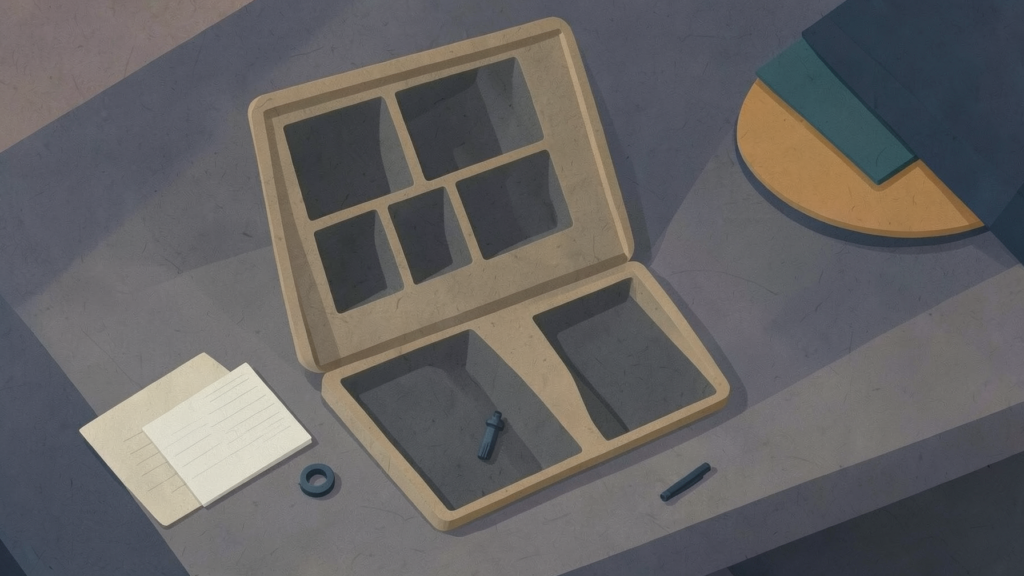
Yasir went back to the shelves with Marwan and laid the signed report beside the inventory sheet. He read the sentence he had sent to the coordinator aloud. Under it he wrote three short questions. How many boxes were in the room? How many kits contained every item on the checklist? Had the club moved the ready kits to the pickup area? He left space for an answer to each question. The same number had slipped from one question to another in the report without his noticing the difference.
Marwan picked up the label on the nearest box and matched its number to the inventory sheet. The number identified the box in front of them. They still needed to find out whether the readiness mark described what was inside it now. They lifted the lid and read the checklist taped underneath. Marwan took the parts out one by one and set them on the table while Yasir followed the corresponding lines with his pen. When they put everything back, Yasir wrote beside the box number that he had seen the parts listed. On a separate line he noted where the box stood. The coordinator might need that detail when someone came to collect it.
They stopped at another box marked ready. A cardboard divider hid some of its contents. Yasir almost copied the mark, then left the space blank. He asked Marwan to set that box aside until they could see underneath. When Fuad came over, Yasir showed him the entry they had checked and the one they still had open. He could explain the error in the report. The replacement figure would take a box-by-box check.
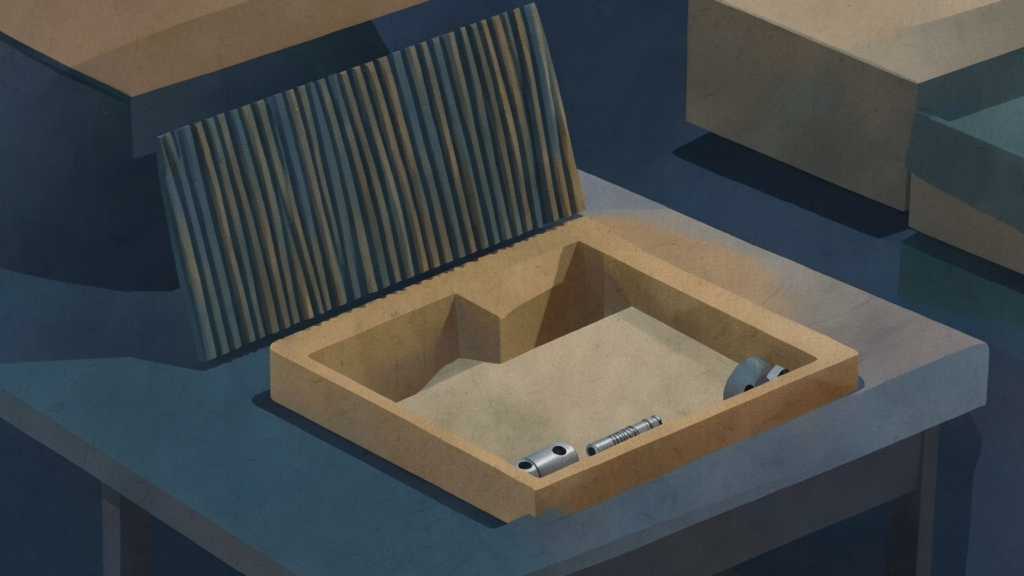
Marwan lifted the cardboard divider from the box they had set aside. A rectangular slot lay empty in the lining. He compared its shape with the sketch on the checklist and pointed to the entry for the missing part. Yasir wrote down the box number and the checklist entry, then moved the label to the side reserved for unfinished kits. They checked the other boxes the same way. One read each box number and its checklist while the other matched them to the inventory and marked the row they had checked.
They counted thirty-six complete kits and twelve boxes that still needed one or more parts. Yasir checked the marks on his sheet before carrying the total into the report. He added the two groups together, then asked Marwan to compare those figures with his own list. When the counts agreed, Yasir copied the row numbers for the incomplete boxes onto the correction sheet. He kept the list of complete kits where Fuad could trace each entry back to a label. All thirty-six kits were still on the club shelves, so he added a line saying they still needed to be moved to the pickup area.
Yasir opened the report he had sent earlier. He kept a copy as the coordinator had received it and recorded that a correction would replace it once approved. In the new draft, he asked the coordinator to reduce the allocation to thirty-six places and pointed to the checked inventory rows. He left the approval box blank. When he handed Fuad the draft, he put the marked sheet beside it so the supervisor could trace the figure back to the boxes.

Fuad read the first line of the correction and asked Yasir to show him how he had reached the number. Yasir opened the check sheet at the marked rows and set Marwan’s list beside it. Fuad chose an entry from each list and went with them to the shelves to see both labels. Then he compared the total with the new allocation request. He asked about the pickup area. Yasir showed him the line saying the kits were still on the shelves. They kept that line so the coordinator would know to wait for a delivery notice.
At the approval box, Fuad asked what Yasir would tell the people who had read the first report. Yasir started to write that the tool had counted wrong. He stopped at “counted” and considered what he had done. The tool had drafted the report from the inventory, and he had copied and signed its statement before checking the readiness marks. He recorded both steps in that order. He added that the correction came from checking the boxes and comparing two lists. The details of the parts stayed in the club record.
Fuad reviewed the correction and the note, then entered his approval. Yasir put the earlier report number in the new message so the coordinator could identify the allocation it replaced. He sent the correction and checked the attachment against the approved copy. The reply confirmed the new allocation of thirty-six places, to be finalized after the delivery notice. Yasir saved the reply in the club record and set a copy of the transfer list beside the complete kits.

On the morning of the exhibit, Yasir and Marwan moved the complete kits to the table by the pickup door. Fuad stood at the far end, matching each number on the transfer list to the label that reached him. When Marwan set down the last box, Yasir wrote the delivery notice. He listed what they had moved and pointed to the checklist with Fuad’s marks. The twelve unfinished boxes stayed on the club’s work list. When the coordinator confirmed the allocation, Yasir filed the reply with the correction.
At the next club meeting, Fuad asked him to prepare a new sheet for borrowed tools. The report form had a signature box with room for one line beside it. Yasir wrote “Where I checked” and asked Marwan to trace the number he planned to put in the report. Marwan went back to the list but found no row with that total. The number came from two rows. Yasir added both row numbers and went through the calculation with him. He signed after Marwan could repeat it from the sheet alone. When he handed over the report, he put the list right underneath it.
Reader activity
Imagine a team preparing a small exhibit. Its draft report says twenty display boards are ready. One row of the team’s table counts twenty boards that arrived. Another records that seventeen are ready to display. Write the sentence you can approve, then give the table name and the row that supports it. If a tool helped draft the sentence, add a line explaining what it drafted and what you checked yourself. Ask a partner to follow your reference and see if they can tell what you checked.